How a Kinematic Viscometer Tester Helps Improve Quality Control in Petroleum and Oil Laboratories
Last Updated on 14 October 2026
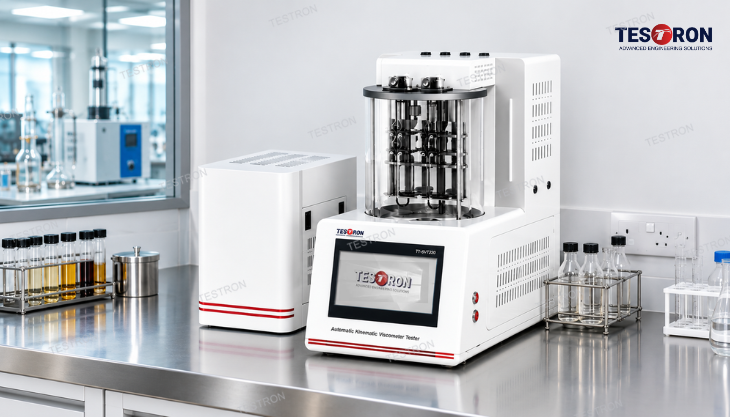
Products made from petroleum must meet certain criteria regarding their quality before being made available for industrial use. With regard to various kinds of refined products made from petroleum, such as fuels, lubricants, and other kinds of petroleum products, viscosity is an important factor for the fluid.
A kinematic viscometer tester is a device that allows the laboratory to perform testing of the kinematic viscosity of petroleum samples under controlled conditions. Automation will help to make the process of quality control better, as the accuracy of measurements and recording of test results and processes will be ensured, and tests will be performed consistently.
Importance of Kinematic Viscosity in Quality Control of Petroleum Products
Viscosity is defined as the resistance to the movement of a substance. In the case of kinematic viscosity, the resistance is compared to the density of the liquid and expressed in mm²/s.
Viscosity is one of the most common measurements in the petroleum laboratory since it indicates how a product will behave in reality. A lubricant that has low viscosity will perform poorly in protecting engine parts. Moreover, low-quality fuel will have poor flow characteristics. Knowing the viscosity of the petroleum product allows quality control specialists to make decisions about its approval or rejection. It is also feasible to use an automatic kinematic viscometer tester to get precise readings for numerous samples.
Identifying Variations Between Samples
The viscosity test assists laboratory personnel in comparing their samples with specifications and previous results. If a particular sample does not meet the specifications, then further analysis may be carried out on that particular product.
This is particularly relevant when laboratories assess:
- Lubricants intended for particular operating conditions
- Fuels requiring specified handling characteristics
- Petroleum products from different production batches
- Samples submitted for routine quality inspection
The use of the same process to test products enables teams to separate any changes that may be caused by the actual product from those that might have been introduced during sample preparation or during measurement conditions. The use of a kinematic viscometer tester will further eliminate any inter-tester differences because the timing, temperature, and calculations are done the same way for each sample.
How a Kinematic Viscometer Tester Improves Measurement Reliability
It’s important to know that getting reliable viscosity results doesn’t depend only on the instrument. It is a matter of an established process that leads to testing samples in the same way every time. A correctly working viscometer plays a role here, as it minimizes the uncertainty in each measurement.
Maintaining Controlled Test Conditions
Temperature plays a major role when viscosity is determined. Small differences in temperature may have an effect on the liquid flow and the accuracy of the comparison.
A kinematic viscometer testing machine, which is specifically designed for tests on petroleum, will help to maintain the required temperature and standardise the test process. According to ASTM D445, the process of determining kinematic viscosity involves measuring the time taken by the liquid to flow through a glass capillary viscometer using the force of gravity.
The method and material test equipment have to be appropriate for the material being tested.
Supporting Repeatable Results
The issue of reproducibility becomes important for laboratories that conduct regular tests on multiple samples. The use of a correct kinematic viscometer testing instrument will ensure repeatability of tests if a correct procedure and proper maintenance of equipment are followed by operators.
Repeatable tests will allow laboratories to evaluate trends and analyze abnormalities in results.
Applications Across Petroleum and Oil Laboratories
Kinematic viscosity testing is relevant wherever laboratories need to assess the flow characteristics of suitable petroleum products.
Where the Equipment Can Be Used
Some common applications are as follows:
- Refineries and petrochemical labs: Testing petroleum products during manufacturing and quality inspections.
- Laboratories for fuel tests: Viscometry in relation to the required standards of the specific product.
- Laboratories for aviation fuel quality control: Facilitating the tests for aviation-related fuels.
- Lubricants testing labs: Evaluating viscosity properties in relation to the specifications of lubricants.
- Research laboratories: Obtaining data for analysis of petroleum products.
In addition to the above-mentioned fields, the method is widely applied in other industries including power production, rail transportation, and research purposes, where oils and fuels need to be tested for their reliable performance.
Why Consistency of Testing Is Important to the Petroleum Industry
Considering the magnitude of the processing of petroleum products, tests are essential within the industry. According to a Reuters article reporting on the EIA’s Short-Term Energy Outlook for December 2024, the United States was projected to refine some 16 million barrels of crude oil per day during the year 2025, which is some 200,000 bpd less than in 2024.
This figure shows how much crude oil and fuel and lubricating products derived from crude oil enter the processes of U.S. industries daily. While it does not quantify laboratory testing in a straightforward manner, it does provide insight into the number of products requiring testing before they can be sold.
Hence, the key practical aspect for laboratories is to ensure that a measurement is taken using a relevant method, under controlled conditions, and using appropriate equipment.
Choice of Appropriate Testing Equipment for Kinematic Viscometers
There is much more to be considered in equipment selection than comparing technical specifications.
The following table summarises the main considerations.
| Selection factor | What laboratories should assess |
| Test method | Compatibility with the required ASTM or ISO procedure |
| Temperature control | Ability to maintain the specified test conditions |
| Measurement range | Suitability for the samples being tested |
| Automation | Timing, cleaning, drying, and result calculation functions |
| Data handling | Saving, printing, and laboratory-system connectivity |
| Maintenance | Cleaning requirements, servicing, and technical support |
A suitable kinematic viscometer testing equipment setup should match the laboratory’s actual workflow. Automation functions alone should not determine whether the required test procedure and samples will be used.
Comparing Price and Long-Term Value
When making a comparison of kinematic viscometer tester prices, the costs involved in operating the apparatus should be considered, and not the price itself. These costs may include accessory costs, disposable costs, training and technical support costs, among others.
This is true for the comparison of kinematic viscometer tester machines. An automated machine can prove its worth in laboratories with high sample volume, but a less complex one may do well in smaller laboratories.
Choosing a Reliable Manufacturer and Supplier
The equipment provider can influence the laboratory’s experience long after the purchase.
A kinematic viscometer tester manufacturer should be able to describe the use of the equipment, the methods of testing that the machine can accommodate, the operational demands of the machine, and the maintenance needed for the equipment. This information is especially helpful when matching the equipment to a particular petrochemical test.
The kinematic viscometer tester supplier must also state the delivery process, installation, training, warranty, and after-sales services. This will aid the laboratory in its preparation for operating the equipment in the future. Buyers must ensure that the specifications of the chosen equipment meet the needs of the testing process to be used.
Building a More Reliable Quality-Control Process
The measurement of viscosity is made accurate by a set of actions taking place, from the sampling stage to the measurement and the verification of the results. Automation helps in making the routine tasks repeatable, but cannot eliminate errors in the procedure of testing or poor maintenance of testing devices.
An appropriately matched kinematic viscometer tester can help laboratories have reliable methods of measuring and useful data logs. In choosing appropriate equipment, laboratories need to take into account the needs of the test, the level of automation required, and other factors before making an investment. If you work in a petroleum laboratory looking for viscosity testers, Testron Group provides equipment for petroleum product testing.