Top Companies to Hire a Fractional AI Development Team in the USA in 2026
Last Updated on 1 October 2026
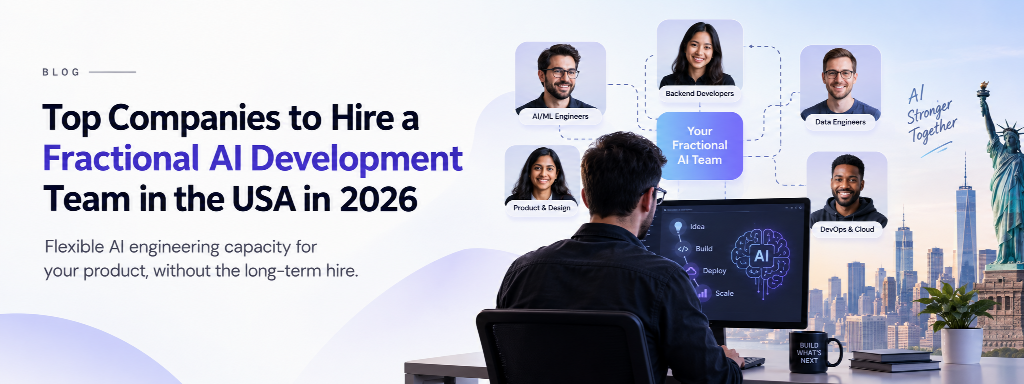
A company’s growth in terms of its AI initiatives and implementation doesn’t need to be limited by its existing resource capacity. Hiring a permanent AI team may also be difficult to justify when the immediate need is tied to one project, product release, or technical gap.
A fractional AI development team is a surefire way to add that capacity. Companies can bring in AI and software engineering expertise to their team or project for a defined period or workstream while their internal teams continue to manage the core product. The model can be useful when a company needs skills in areas such as AI application development, data, backend engineering, cloud infrastructure, security, or model evaluation without building every role in-house.
The choice still requires careful evaluation, as the team needs to work with existing systems, understand production requirements, and fit the company’s delivery process. This article looks at companies in the USA that provide AI development capabilities for organizations considering a fractional team in 2026.
When Does a Company Need a Fractional AI Development Team?
A company does not need a fractional AI development team simply because it wants to add AI to its product. The model makes more sense when there is a defined technical need but not enough internal capacity or specialist experience to handle it. Several situations can point to that gap.
1. When the AI roadmap is ahead of the engineering team
A fractional team can take responsibility for a defined AI workstream while the internal team continues its existing product work. This arrangement can be useful when the company already knows what it wants to build but needs additional engineering capacity to get started.
2. When the project needs skills the team does not have
AI development can involve several areas of engineering at once. Hiring one AI engineer may not cover all of these needs. A fractional team can bring together different skills for the duration of the project instead of requiring the company to create a permanent role for every capability it needs.
3. When a prototype has to become a production system
The prototype may have been built quickly, but turning it into something that can operate alongside an existing product requires engineering work across the stack. A fractional team can provide that capacity when the internal team has the product knowledge but not enough time or production AI experience.
What Should Companies Look for in a Fractional AI Development Team?
A fractional AI development team should be able to build the AI capability, connect it to the existing system, and work with internal engineers.
1. AI and software engineering depth
When an AI functionality exists within the software product, this makes software engineering experience as important as AI expertise. Companies should look for teams that can handle both sides of the work.
2. Ability to work with existing teams
A fractional team should add capacity without creating confusion about who owns the work. Internal developers may continue handling the main application while the fractional team takes responsibility for a defined AI component, such as a recommendation workflow or an internal knowledge assistant.
3. Production readiness
Companies should examine how a fractional team handles security, evaluation, monitoring, scalability, integration, and deployment. These considerations help distinguish a production engineering approach from a proof of concept.
4. Flexible engagement model
Companies can look for providers that support defined workstreams, adjustable team composition, and different levels of involvement as the project develops. This keeps the external team aligned with the work.
5 AI Development Partners for Flexible Engineering Capacity in the USA
Take a look at the list of companies that offer AI and software engineering capabilities, relevant for organizations looking for an added advantage of external capacity for their existing product or engineering team.
1. GeekyAnts
GeekyAnts is an AI-Powered Digital Product Engineering & Consulting Company with capabilities across AI engineering, frontend and backend development, cloud, DevOps, quality assurance, security, and application modernization.
Its AI engineering work includes RAG systems, AI agents, LLM-based applications, and AI integrations, while its broader engineering capabilities cover the APIs, databases, infrastructure, testing, and deployment needed to connect AI features with existing products. Their engineering expertise supports companies that need additional AI engineering capacity while their internal teams continue managing the core product.
Clutch Rating: 4.9 (120 reviews), Address: 315 Montgomery Street, 9th & 10th Floors, San Francisco, CA 94104, USA, Phone: +1 845 534 6825,
Email: info@geekyants.com, Website: geekyants.com/en-us
2. Flyaps
Flyaps is a custom software development company with capabilities across AI/ML development, intelligent automation, cloud-native software, DevOps, and IT staffing. Its AI work includes agentic AI solutions, custom machine learning models, and generative AI integrations.
Their services can fit fractional AI engagements where a company needs additional engineering capacity without separating AI work from the wider product environment. Its senior IT staffing offering also supports short- and long-term capacity needs, which can be relevant when engineering requirements change during an AI initiative.
Clutch Rating: 4.8 (15 reviews), Address: 106 West 32nd Street #139, New York, NY 10001, USA, Phone: (646) 980-6809
3. Achievion Solutions
Achievion Solutions focuses on AI solutions, machine learning, custom software development, AI agents, and generative AI. Its services also cover web and mobile application development, allowing AI capabilities to be connected with the software surrounding them. This can be relevant to fractional engagements where a company has an AI use case but needs additional engineering support to turn it into an application.
Clutch Rating: 4.8 (17 reviews), Address: 1750 Tysons Blvd, Suite 1500, McLean, VA 22102, USA, Phone: +1 703 957 9775
4. Utility
Utility is a digital product agency offering mobile app development, web platforms, custom software, and AI-powered solutions. Its capabilities bring together product strategy, UX/UI design, AI engineering, and software development, which can be useful when an AI initiative requires changes across the product rather than only the AI layer. For a fractional engagement, this broader product scope can help when AI functionality needs to be connected to customer-facing applications, backend services, or existing digital products.
Clutch Rating: 4.8 (26 reviews), Address: 135 Madison Avenue, New York, NY 10016, USA, Phone: (212) 328-1167
5. Rootstack
Rootstack is a software development company with capabilities across AI development, custom software, cloud infrastructure, web and mobile development, and IT staff augmentation. Its AI work sits alongside broader software engineering, which can be useful when an AI initiative requires changes to existing applications and infrastructure.
The combination of AI development and staff augmentation can also support companies that need to add engineering capacity for a defined period. This makes its services relevant to projects where internal teams need additional support without changing ownership of the core product.
Clutch Rating: 4.8 (21 reviews), Address: Dobie Center, 2021 Guadalupe Street, Suite 260, Austin, TX 78705, USA, Phone: +1 215-883-4359
Conclusion
A fractional AI engagement works best when the work has a clear boundary from the get go. Validation needs to happen in parallel with the development process, where teams can test the AI system, review its responses, check integrations, monitor performance, and address security issues before the system reaches more users. Once the work is ready for handoff, documentation should cover the architecture, workflows, integrations, deployment process, and key operating decisions.
The final stage is either scaling the engagement or handing the system back to the internal team. In both cases, the company should know what has been built, who owns it, how it operates, and what needs to happen next. That structure gives the organization room to add AI engineering capacity without giving up control of the product.