Gift Culture Has Gotten Weird: Why People Are Moving Back to Food and Experiences
Last Updated on 15 August 2026
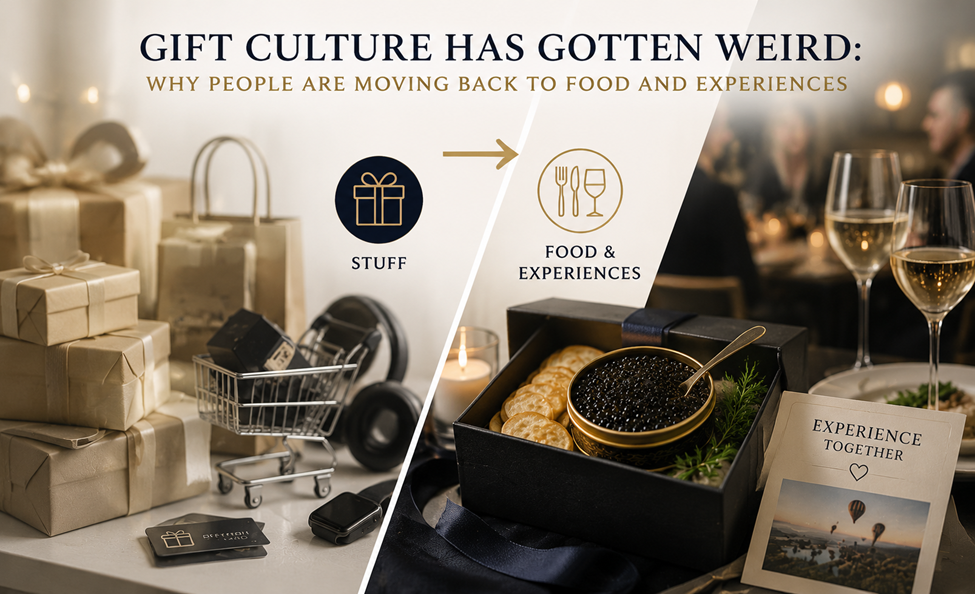
Think about the last physical gift you received that you actually wanted. Not a gift card, not something you politely said you loved and quietly moved to a shelf. Something you were genuinely glad someone bought you. If you’re struggling to come up with a recent example, you’re probably not alone. Gift giving has gotten strange in a way that most people sense but rarely say out loud: we’re all buying things for each other that neither party particularly needs, wrapping them in paper that goes straight in the trash, and calling it celebration. There’s a reason food gifts have been growing as a category for several years running, and why places like caviar store Bester Caviar see a consistent spike in orders around holidays and birthdays that has nothing to do with people buying for themselves.
The shift toward edible and experiential gifts isn’t a trend in the sense that it’ll reverse in a couple of years. It’s a correction. People got tired of the alternative.
Nobody Needs More Stuff and Everyone Knows It
The average American household owns more physical objects than at any point in history. Storage unit rentals are a multi-billion dollar industry that didn’t really exist fifty years ago. There are entire professional services built around helping people get rid of things they own but don’t use. Marie Kondo became a household name because she gave people permission to throw away the accumulation of years of well-intentioned gift giving.
Against that backdrop, buying someone another object requires a pretty strong justification. You need to know specifically what they want, that they don’t already have it, and that it’s something they wouldn’t buy for themselves. That’s a high bar. Most gifts don’t clear it. What they do instead is add to the pile.
This is why the question “what do you want for your birthday?” so often gets answered with “nothing, really” or a vague shrug. It’s not false modesty. It’s an accurate assessment. Most adults who want something either already have it or are going to buy it themselves. The gift economy hasn’t caught up to that reality yet, but the behavior is changing even if the ritual hasn’t.
How Gift Culture Got So Exhausting
Part of the problem is that the infrastructure around gift giving has made it easier to give bad gifts at scale. Amazon wishlists are convenient but they turn the act of choosing a gift into order fulfillment. You pick something off a list, click buy, and the whole point of the gift, that someone thought about you specifically and found something suited to you – disappears. It becomes logistics.
Gift cards are even more stripped down. They’re transferring money with extra steps and a fee built in. Most recipients would prefer the cash. Most givers know this and give the card anyway because handing someone an envelope of money feels too blunt, even though it’s functionally identical and more useful.
The holiday gift exchange, the office white elephant, the birthday present for someone you see twice a year: these rituals have calcified into obligations that neither party enjoys much. You buy something. They receive it. Everyone performs gratitude. The thing ends up at Goodwill inside six months. It’s not anyone’s fault. The whole structure has just run out of purpose.
Why Food Gifts Work When Other Gifts Don’t
Food gifts solve almost every problem that makes physical gifts awkward. They don’t accumulate. There’s no wrong size. You can’t already own them. They don’t require knowing someone’s taste in objects, just a rough sense of whether they enjoy eating well, which is true of most people.
The consumable nature is the actual feature, not a limitation. A bottle of good olive oil, a tin of aged cheese, a well-chosen bottle of wine: these things get used, create a moment, and disappear without leaving clutter behind. The memory of the experience is what stays, not an object that needs to be stored somewhere.
There’s also something honest about food gifts that object gifts often lack. When you give someone a physical thing, there’s an implicit claim that you know what they want better than they do. When you give them something good to eat or drink, the implicit claim is just: I thought you’d enjoy this, and I wanted you to have a nice moment. That’s a much easier bar to meet, and it lands more often.
What People Are Actually Buying Now
The premium end of food gifting has gotten genuinely interesting over the past few years. It’s not just wine and chocolate boxes anymore. The best gifts for foodies right now tend to be things people wouldn’t typically buy for themselves, specific enough to feel considered rather than generic.
Aged vinegars, single-origin spices, small-batch preserves, really good olive oil from a named estate: all of these have grown as gift categories because they hit the sweet spot of being genuinely useful, genuinely good, and not something most people pick up on a regular grocery run. Luxury food gifts in this range, typically $50 to $150, have been growing faster than the overall gift market for several consecutive years according to specialty food retailer sales data.
Caviar gift sets are an interesting case study in how this works at the higher end. A caviar gift box with a tin of Royal Osetra or Beluga Hybrid caviar, a set of mother of pearl spoons, and a small tin of French blinis is around $199 at direct import prices. That’s a meaningful amount of money. But it’s also a complete, specific, memorable experience that the recipient almost certainly wouldn’t buy for themselves, arrives in a format that’s genuinely beautiful to open, and gets consumed in one sitting with people they care about. Compare that to $199 spent on a random object and the case for the caviar isn’t hard to make.
What Makes a Food Gift Actually Land
The difference between a food gift that works and one that doesn’t usually comes down to one thing: specificity. A generic food basket from a department store doesn’t say anything about the recipient. It says you had a budget and a deadline. A well-chosen single item says you thought about what this particular person would actually enjoy.
This is why caviar gift boxes work better as gifts than generic food assortments, even at a lower price point. A box of random crackers and preserves is pleasant but forgettable. A tin of caviar with the tools to serve it properly is a specific statement: I thought you’d enjoy something genuinely special. That’s the whole point of a gift, and it’s the thing most gift giving has lost.
The other element that matters is presentation. Food that arrives well packaged, in a format that feels considered rather than thrown together, lands differently than the same product in a plain box. This is why direct importers who ship caviar in Styrofoam coolers with gel packs and good packaging aren’t just solving a logistics problem. The unboxing is part of what makes it feel like a gift rather than a grocery order.
None of this requires spending a lot of money. A single excellent ingredient, chosen with the recipient in mind, wrapped in a way that shows it was thought about, is a better gift than something three times the price picked off a wishlist. The shift back toward food and experiences isn’t about spending more. It’s about spending on things that actually create a moment, rather than things that just create more clutter.