Cleansing Before a Professional Facial and Where Foam Cleansers Fit
Last Updated on 19 November 2026
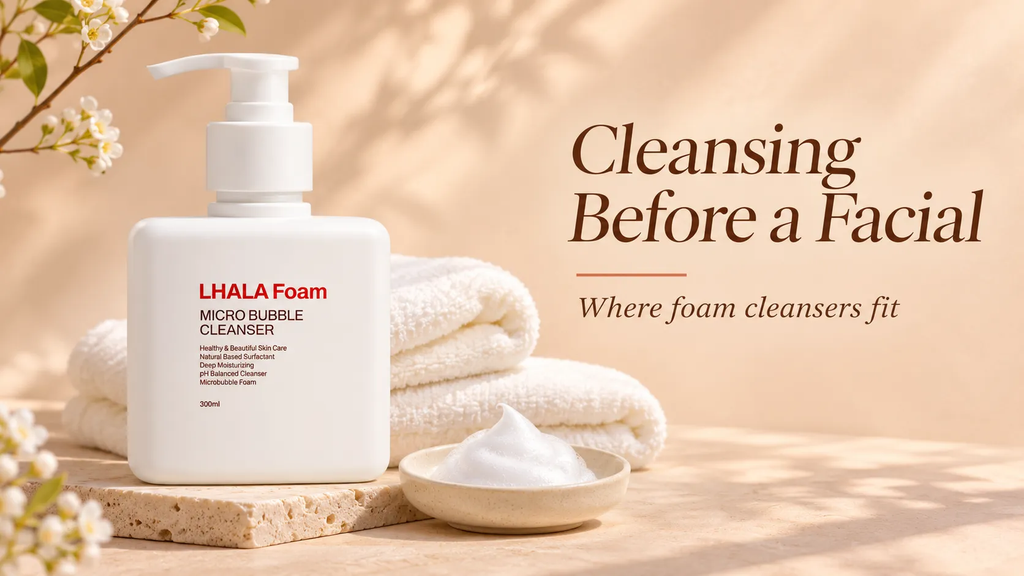
Cleansing before a professional facial has a specific purpose: remove the surface material that would interfere with assessing and treating the skin, while keeping the face comfortable. It is not an endurance test, and stronger degreasing is not automatically better preparation. A good opening step leaves the practitioner able to see the skin clearly and choose what should happen next.
Foam cleansers are one option within that opening step. The micro-foam cleanser from Lhala is positioned in a professional skincare range as a cleansing product. Understanding its place is useful for practices building a facial menu: cleansing, exfoliation, and finishing products should have distinct jobs, rather than overlapping because a routine contains several bottles.
Start With the Skin That Actually Arrives
A client may arrive wearing makeup, water-resistant sunscreen, or very little product. Another may already have washed thoroughly before the appointment. These starting points should not be treated as the same removal problem. An identical, lengthy cleansing ritual for everyone can add time without adding value.
Before choosing a cleanser, ask what is on the face and how the skin has felt that day. Recent tightness, unusual stinging, or a new skincare product provides context for the appearance in front of you. The goal is not to turn the conversation into an elaborate intake exercise; it is to avoid making an obvious mismatch between the removal task and the approach selected.
Consider a hypothetical appointment involving long-wear foundation. Visible makeup removal deserves attention before evaluating the underlying complexion. Contrast that with a client who arrives bare-faced and reports dryness after a morning wash. Repeating an aggressive removal process in the second situation would solve a problem that is not there. This distinction is an everyday service decision, not a reason to rank one cleanser as universally stronger.
What Cleansing Can and Cannot Accomplish
Cleanser science centers on the removal of unwanted surface material. Surfactants help oily residue interact with water, while the complete formulation influences cleansing and effects on the outer skin barrier. The review by Mijaljica and colleagues explains why surfactant selection and formulation deserve attention beyond a product’s texture or natural-origin messaging.
For a facial service, translate that principle into a practical endpoint. Visible cosmetic residue should be addressed, but skin does not have to feel stripped before the appointment can progress. A film-free appearance and a comfortable finish are more relevant than a dramatic squeak when fingers move over the face.
Cleansing also does not mean sterilizing skin. Removing makeup and excess oil is a different objective from a procedure-specific antiseptic preparation. A cosmetic foam belongs to its stated cosmetic role. Keeping those purposes separate prevents a facial menu from promising more than an opening wash actually provides.
Where the Lhala Foam Format Fits
H2MEDI lists LHALA Foam as a 300 mL cleansing product and describes a micro-bubble format. The manufacturer’s published range is pH 5.5 to 7.5, which should be understood as a range rather than one fixed pH. It spans slightly acidic, neutral, and slightly alkaline conditions.
The format can be helpful when a practice values visible coverage and a light application feel. However, the appearance of fine bubbles should not become the treatment objective. Staff should be able to explain that a foam is being used for cleansing, rather than saying that more bubbling proves better penetration or a more effective facial.
Choose placement by purpose. A cleanser can introduce the appointment and support removal before a separate treatment is considered. It should not inherit every claim associated with that treatment. Equally, a satisfying cleansing experience does not establish that a later peel or mask will perform better in every client.
Keep Cleansing and Exfoliation Separate
Cleansing primarily addresses unwanted material on the surface. Exfoliation deliberately addresses superficial skin-cell shedding or removal through a selected product or method. These functions may overlap in a formulation, but the overlap does not make all cleansers peels or all peels substitutes for washing.
This distinction improves facial design. If the client’s primary need is simple residue removal and a comfortable finish, an extensive exfoliating stage may not be the point of the appointment. If texture is the stated concern, the practitioner can assess that concern after cleansing instead of assuming that a stronger wash has already treated it.
The useful question is therefore, what does the next step contribute? A second bottle should have a reason to be there. A routine becomes harder to understand when every product is described as deep cleaning, resurfacing, hydrating, and brightening at once. Clear roles also make a recommendation easier for the client to remember afterward.
| Stage | Main purpose | Useful observation | Misleading target |
|---|---|---|---|
| Initial cleansing | Remove surface cosmetics, oil, and residue | Remaining visible film and skin comfort | Maximum foam or a squeaky finish |
| Reassessment | Understand the now-visible complexion | Local dryness, texture, and client feedback | Assuming every face needs the same next step |
| Selected exfoliation | Address a defined superficial texture objective | Fit with the assessed skin and chosen product | Repeating the strongest step available |
| Finishing care | Support the intended finish and comfort | How the final products feel together | Adding products simply to lengthen the service |
Technique Can Distort a Product Comparison
A cleanser that seems comfortable in one service can feel different when staff use more friction, hotter water, or repeated passes. The American Academy of Dermatology recommends gentle cleansing, discourages scrubbing, and advises lukewarm water and gentle drying. These broad principles help keep application behavior from becoming the hidden variable in a comparison.
In practical terms, separate a formulation issue from a service habit. If several clients complain that the cleansing stage feels rough, changing the bottle may not answer the problem if the same vigorous rubbing continues. Review what staff actually do, what they ask the client, and when they decide that removal is complete.
The same reasoning applies to rinse-off quality. Residual product can influence how a finishing cream spreads or feels. Before adding a new treatment explanation, make sure the cleansing step has been completed according to its directions. A clear endpoint is more reproducible than an informal rule to keep working until the skin feels extremely clean.
Choosing Between Foam and Other Formats
A foam, cream, gel, or oil-based cleanser may earn a place in a service for different reasons. A practice does not need to force one texture into every situation. The product should match the residue, the complexion, and the intended experience, with the complete formulation considered alongside the format.
Draelos’s review of cleanser science describes differences between soaps and synthetic detergent systems and explains why cleanser chemistry matters to irritation and dryness. That evidence supports assessing formulation, rather than assigning mildness from a texture name alone. It does not establish a clinical advantage for every foam over every cream.
There is also a service-design decision. A practice with many clients wearing substantial makeup may want a clearly defined removal option. A menu focused on simple maintenance may prioritize a straightforward wash that staff can explain consistently. These are reasons to select a manageable set of products, rather than stock several near-identical cleansers with no clear distinction between them.
Make Feedback Specific Enough to Use
Asking whether the cleanse was nice produces limited information. Ask whether the client noticed tightness, whether a familiar area stung, or whether the skin still felt coated afterward. Specific observations help distinguish scent preference, application feel, and actual comfort instead of collapsing them into one vague satisfaction score.
For an internal comparison, keep the questions consistent. Record the starting residue and any immediate feedback in the ordinary service notes. This does not turn an informal observation into clinical proof. It simply creates a clearer basis for deciding whether the product fits the practice’s needs.
Avoid presenting one positive response as evidence that the cleanser suits everyone. A more defensible recommendation identifies the job the product performed and the experience reported. This also makes future adjustments easier: staff can change a particular step for a particular reason instead of rewriting the whole facial around a single reaction.
Common Facial Menu Mistakes
One mistake is treating double cleansing as mandatory regardless of the face in front of you. A second removal step should solve an identifiable problem, not merely make the service sound more thorough. Another is confusing exfoliation with cleanliness and increasing intensity when the actual issue is leftover makeup.
A third mistake is making the cleanse responsible for the entire facial’s outcome. If the client’s goal concerns texture or hydration, discuss which selected stage addresses that goal and how it will be evaluated. The cleanser can do its own job well without being credited with every later improvement.
Finally, broad descriptions such as suitable for all skin types should not replace individual judgment. DermNet’s cleanser guidance notes that a product’s hypoallergenic positioning does not eliminate the possibility of irritation or allergy. That is a reason to listen to the client and read the formula, not to turn the appointment into a warning lecture. [5]
Frequently Asked Questions
Does a professional facial always need a foaming cleanser?
No. Foam is one format. Choose the cleanser for the material being removed, the skin being assessed, and the service that follows. A practice can offer a foam without making it the compulsory answer to every cleansing situation.
Does more foam mean the skin is cleaner?
No. Foam describes a visible part of the product experience. Evaluate remaining residue and comfort instead. More bubbles do not establish better removal of a particular foundation or prove that a formula is gentler.
Is cleansing enough to replace an exfoliating step?
They serve different purposes. Whether exfoliation belongs in a particular facial depends on the objective and assessment. The important point is to make that decision separately rather than assuming that a long cleansing stage accomplishes both jobs.
What should staff explain about Lhala Foam?
Explain its role as a micro-bubble cleanser and its place at the opening of the routine. Focus on the actual product directions and intended cleansing task. Avoid adding claims about deeper oxygenation or guaranteed improvements in later treatment results.
How can a practice make product selection more consistent?
Agree on a few simple questions about starting residue, current comfort, and the purpose of the next step. Then use the same observations when reviewing the experience. Consistency comes from clear decisions, rather than requiring an identical ritual for every client.
Build a Routine With Clear Roles
Practices reviewing FillersFairy professional skincare supplies can start with the cleansing job their facial menu actually needs. Compare product formats, identify the role of each later step, and choose a sequence staff can explain clearly. A focused routine gives both practitioners and clients a better understanding of what each product contributes.
References
1. Mijaljica D, Spada F, Harrison IP. Skin Cleansing without or with Compromise: Soaps and Syndets. Molecules. 2022;27(6):2010.
2. H2MEDI Co., Ltd. LHALA Foam. LHALALA product information. Undated.
3. American Academy of Dermatology Association. Face washing 101. Undated.
4. Draelos ZD. The science behind skin care: Cleansers. Journal of Cosmetic Dermatology. 2018;17(1):8-14.
5. Oakley A. Soaps and cleansers. DermNet. 1999.