Flatbed Hotshot Truck Conversions: How to Properly Mount a Heavy-Duty
Last Updated on 1 October 2026
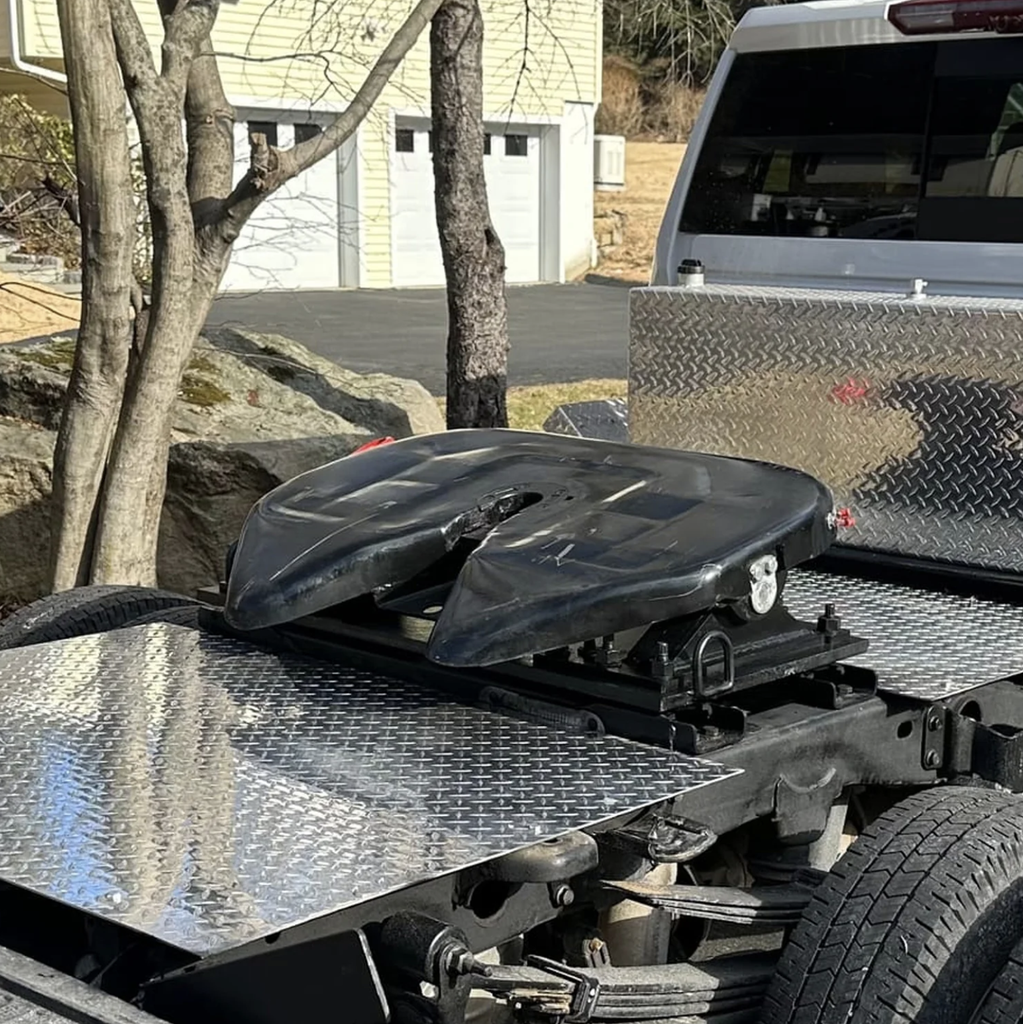
Converting Pickup Trucks to Flatbeds for “Hotshot” Transport
Converting medium-duty “hotshot” trucks—such as the Ram 3500 or Ford F-350—into heavy-duty flatbed configurations is a common practice. Unlike standard factory beds, a flatbed typically features a specialized support structure and mounts directly to the vehicle’s chassis. This creates a distinct foundation for installing a heavy-duty fifth wheel hitch system. In some cases, original factory components may no longer be usable; therefore, the conversion must be executed based on precise engineering calculations. The process must also carefully account for rear-axle limits and weight distribution, without overlooking vehicle stability and traction.
In this article, we will explain how a hotshot truck can be converted into a heavy-duty flatbed configuration.
Selecting the Right Mounting System for Flatbed Vehicles
The first step in installing a 5th wheel hitch system on a flatbed vehicle is determining the correct mounting system. This process should not rely solely on the strength or surface of the flatbed itself; instead, the installation must be guided by mathematical data and engineering or technical expertise. Failure to do so could lead to hazardous situations and serious complications.
Crossmembers, brackets, and specialized mounting hardware may be required to transfer towing forces and pin weight to the vehicle’s chassis. A decision must also be made regarding whether to use a sliding or fixed fifth wheel hitch, based on the specific trailer and truck configuration. Sliding systems are advantageous for tight turns, whereas fixed systems are preferred when there is sufficient clearance between the cab and the trailer. This choice depends on the intended use, the operating environment, and the nature of the work. The mounting system must be compatible with the design of the fifth wheel hitch and correctly positioned over the rear axle. Mathematical calculations are also essential; the vehicle’s Gross Vehicle Weight Rating (GVWR) and Rear Gross Axle Weight Rating (GAWR) must be determined to ensure the entire system can safely handle the intended load.
Positioning the Fifth Wheel on a Flatbed Truck
Proper positioning of the fifth wheel hitch is crucial for ensuring stable weight distribution, maintaining good handling, and avoiding hazards on a flatbed truck. The hitch is typically positioned directly over or slightly ahead of the truck’s rear axle; this ensures that the trailer’s pin weight is effectively transferred through the chassis and rear suspension. Placing the hitch too far behind the axle can overload the rear axle, negatively affecting handling. Conversely, placing it too far forward reduces the clearance between the truck cab and the trailer, which can cause problems during turns.
Before finalizing the mounting location, the dimensions of the flatbed and the design and geometry of the trailer must be considered. Drivers require adequate clearance between the flatbed and the cab during turns and when navigating sharp curves or uneven terrain; this factor must be taken into account. Additionally, as previously mentioned, Gross Axle Weight Rating (GAWR) and alignment should not be overlooked.
Step-by-Step Installation of a Heavy-Duty Fifth Wheel Hitch
As previously mentioned, mounting a heavy-duty 5th wheel hitch onto a flatbed truck requires experience and careful calculations. However, in this article, we will outline the necessary steps as clearly as possible.
First, inspect the truck chassis and the flatbed’s support structure to identify mounting points. Next, determine the hitch’s position based on the rear axle location, trailer clearance, and manufacturer specifications. Install the brackets and cross-members.
Once the mounting structure is positioned and secured, place the fifth wheel hitch according to the installation specifications and fasten it firmly. Adhere strictly to the manufacturer’s torque specifications; incorrect torque—whether too high or too low—can lead to various problems. Check the alignment after installation. Finally, connect the trailer and ensure the mechanism is fully locked. Do not skip the pull test; any issues must be resolved before hitting the road.
Safety Checks After Installing a Fifth Wheel Hitch on a Flatbed Truck
Ensure that all mounting brackets, crossmembers, and fasteners are secured according to the manufacturer’s specifications. Inspect the flatbed structure and the truck chassis; check for any deformation or cracks. This is a crucial step.
Carefully inspect the locking jaw, as well as the position and alignment of the fifth wheel hitch. Do not hesitate to seek professional assistance if you encounter a problem you cannot resolve yourself. Ensure every check is completed thoroughly before hitting the road.